dterm: nanofil's source as pages, and documentation as relations
dterm draws nanofil's Prolog as web pages (web/dterm.pl,
published with the Filnix wiki at mbrock.github.io/filnix/nanofil).
This file records where it comes from, what it does, and the change it
asks of how nanofil is written: documentation is a relation of
the module, doc/3, and its examples are tests.
Lineage
dterm is the latest in a line of renderers that draw code as what it is, not how it was typed.
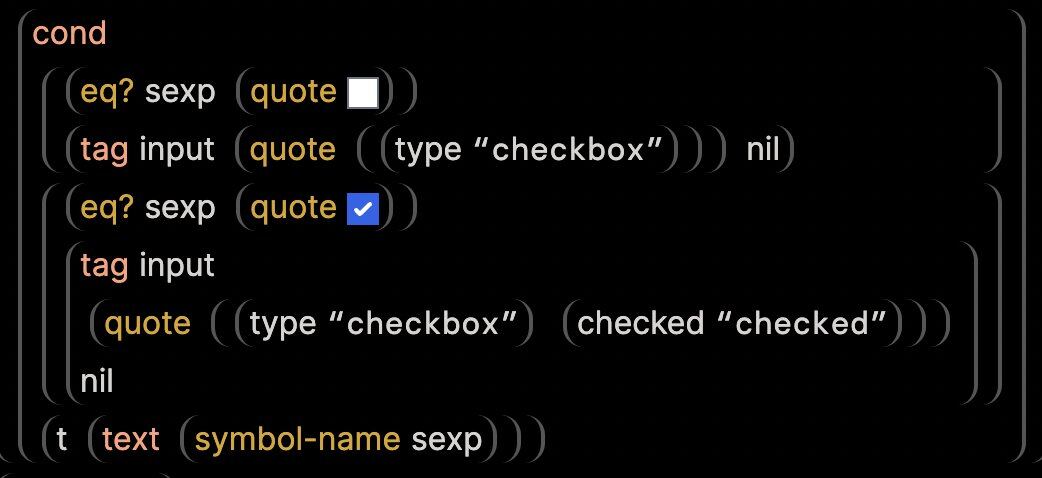
wisp's dexp (mbrock/wisp) was the first: a structure editor for Lisp in which every list is a box whose side borders are its parentheses. Atoms are inline; boxes flow and wrap with the width, so the layout is responsive without any line-breaking logic.
luv's dexp (mbrock/luv, wiki/dexp.lisp)
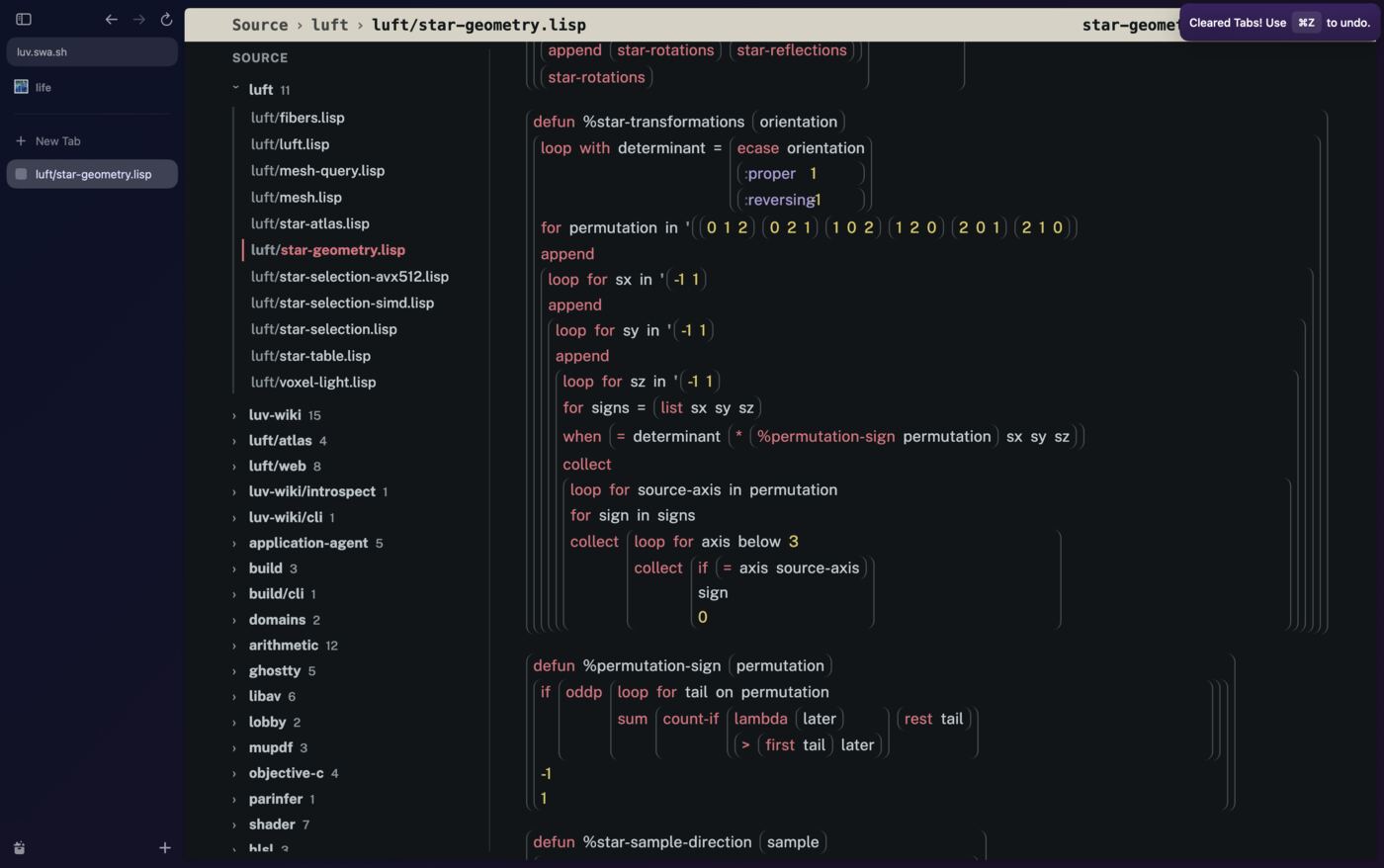
took that to a whole wiki. A small table of operator layouts
(body forms stack, binding forms are two-column grids, cond
is a table of tests and bodies) assigns roles in Lisp; the stylesheet
only knows the roles. Lambda lists come from introspecting the running
image, and docstrings render as prose with symbol references linked.
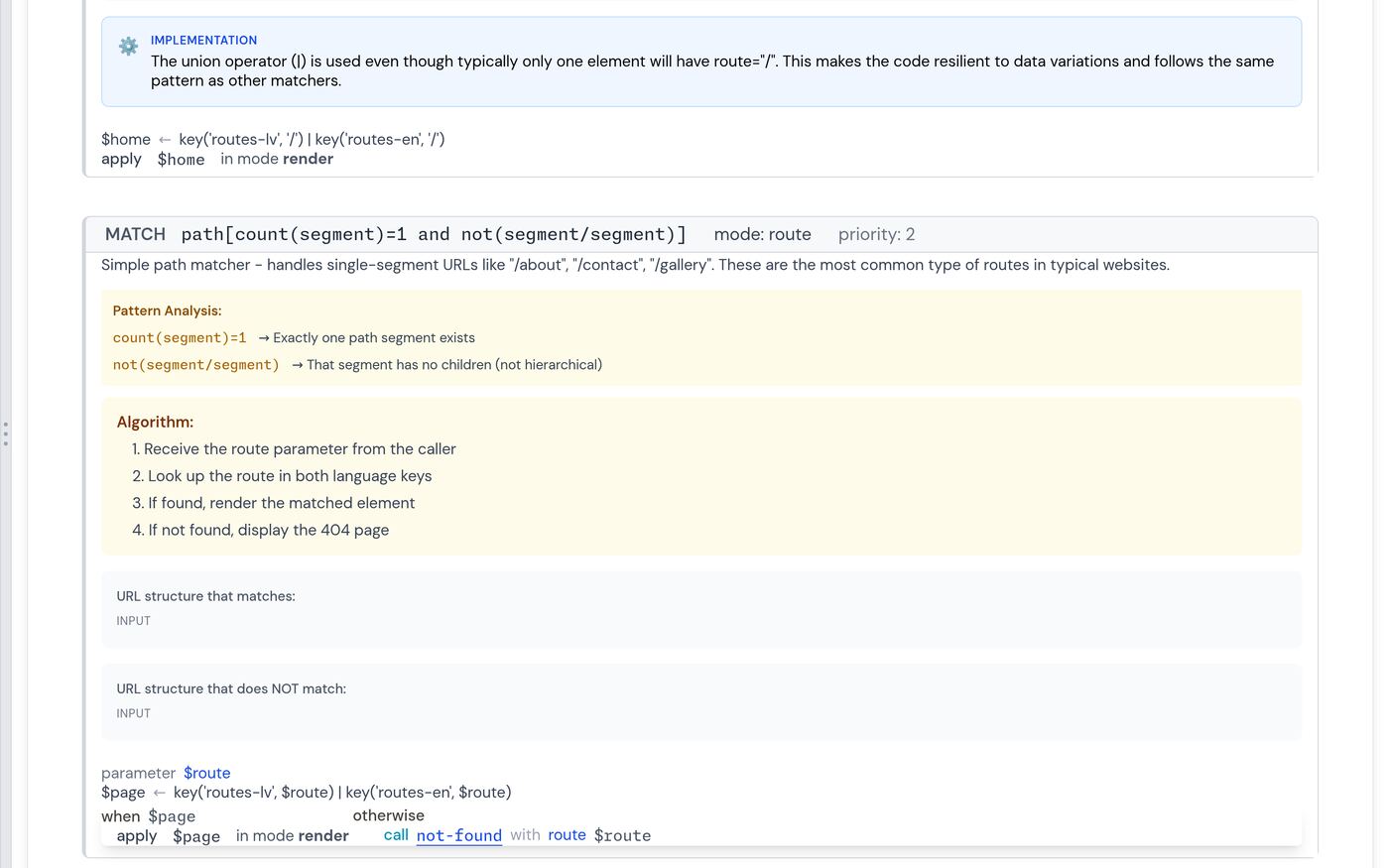
bsd's xslt-doc (mbrock/bsd,
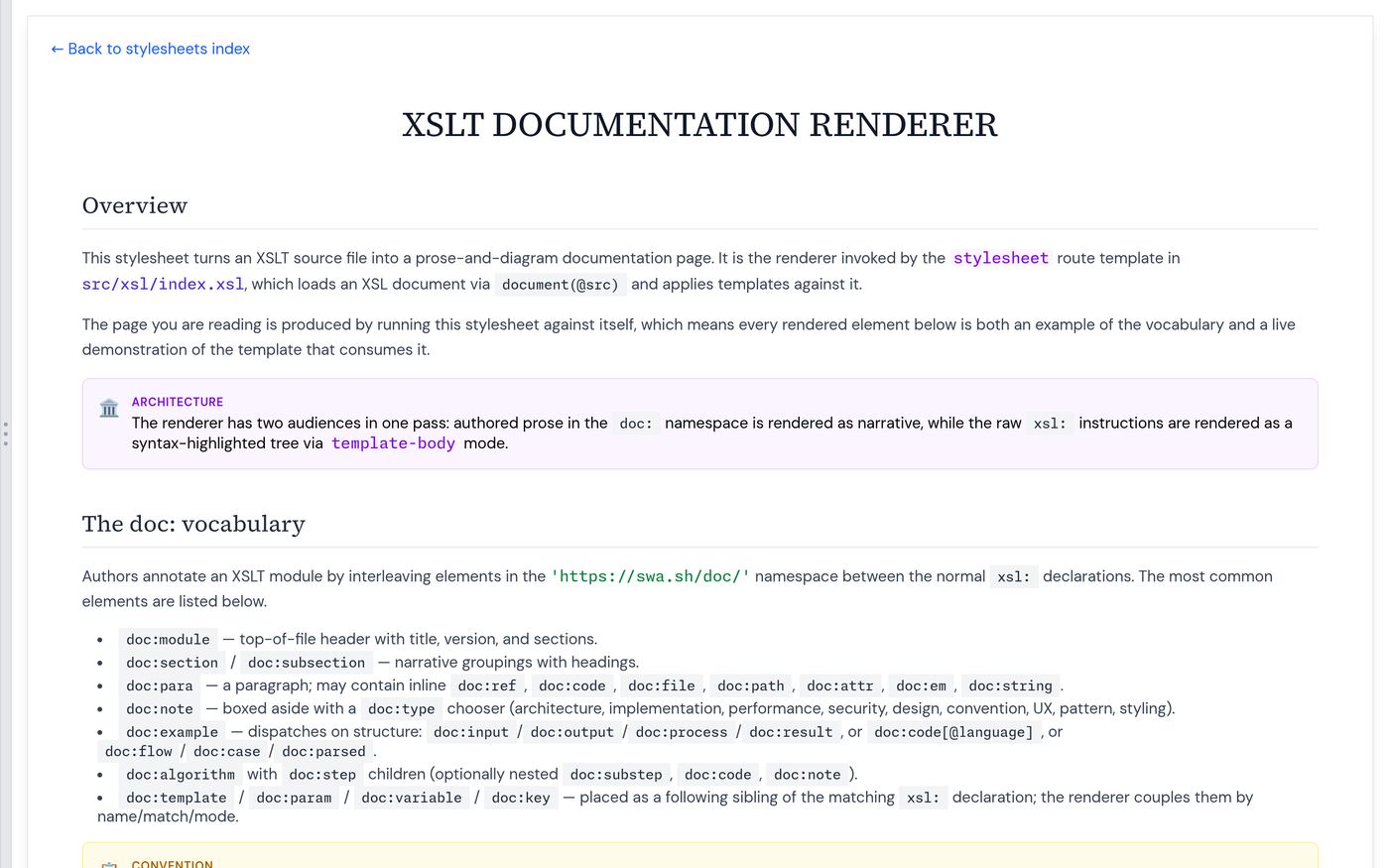
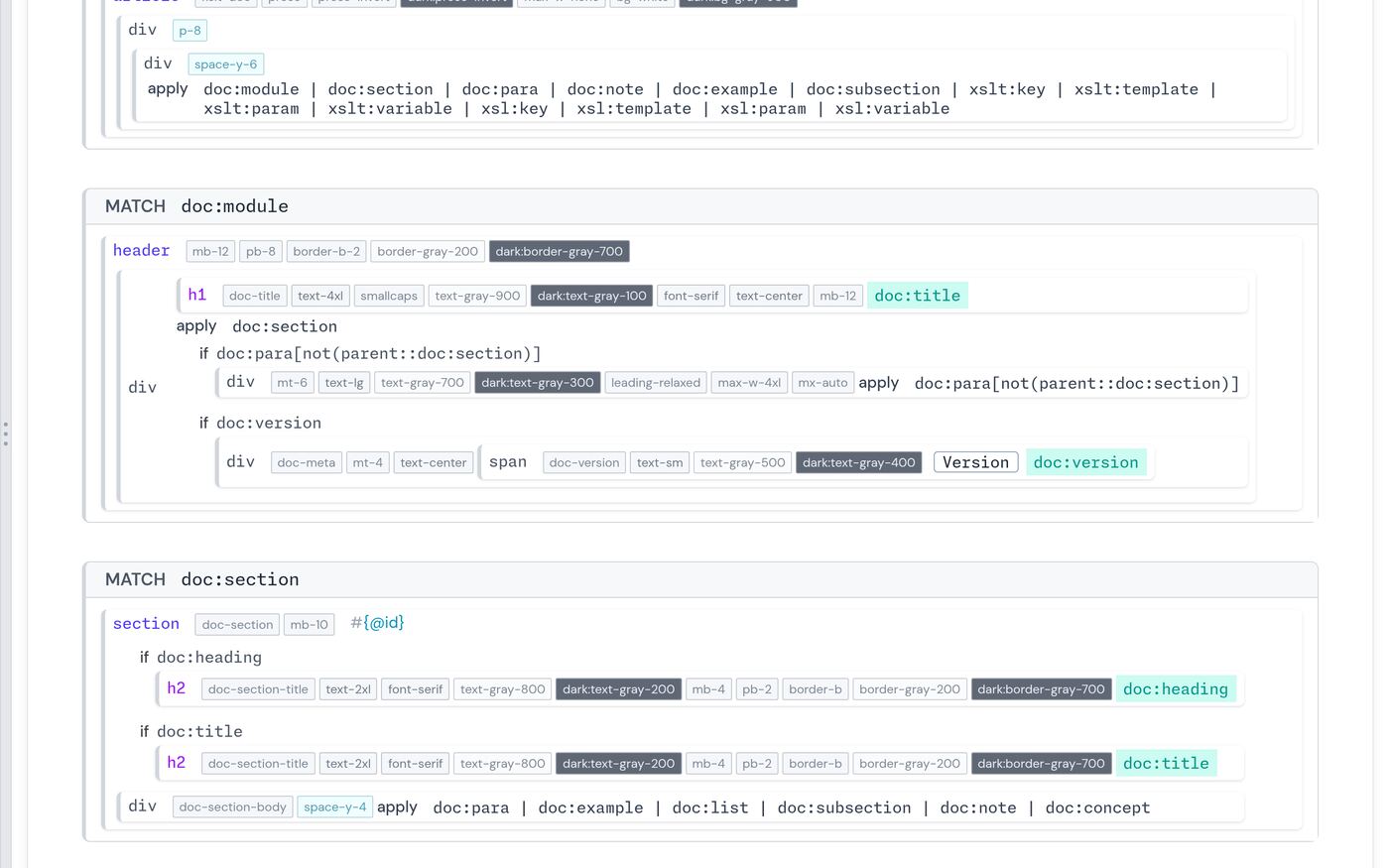
src/base/xslt-doc.xsl) went the other way: it documented
code with structured data in the language itself. XSLT is XML,
so documentation is elements in a doc: namespace between
the xsl: declarations: modules, sections, typed notes,
algorithms, examples with real XML input, and pattern analysis
that explains each predicate of a match. The processor ignores the
doc: elements when it runs the stylesheet; the renderer
reads them like any other node. The renderer documents itself with the
vocabulary it renders. Its weakness showed later: the richest
documentation (routing.xsl's 257 doc: elements) was dropped
as the code moved on, because nothing checked it.
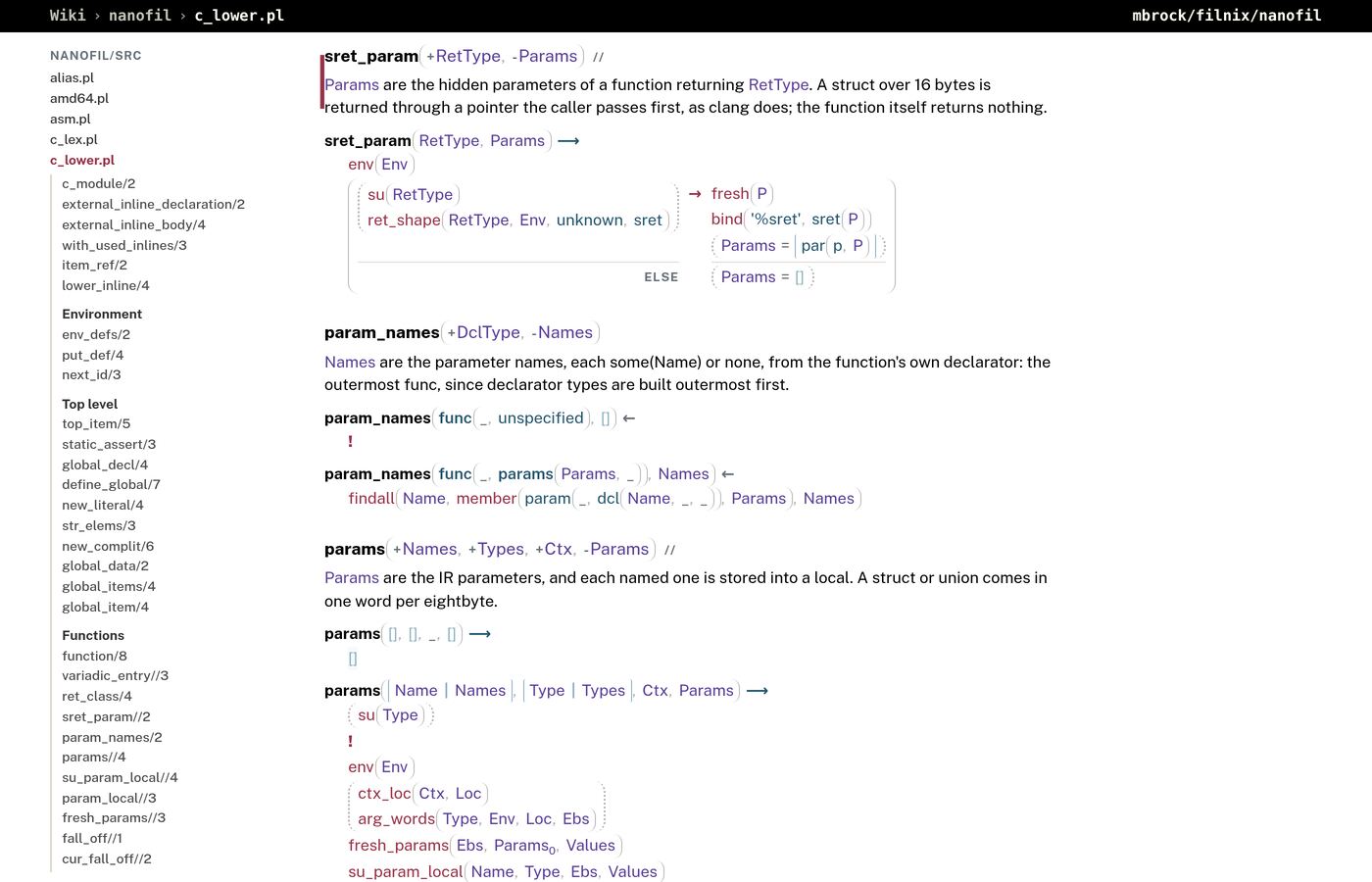
dterm v1 (October 2026) was dexp for Prolog, written in Prolog: a compound is its functor and a parenthesis box, a clause is its head over one goal per row, if-then-else chains are tables, a predicate of short facts is a table, PlDoc comments become signatures. It inferred all its structure from the code and the comments.
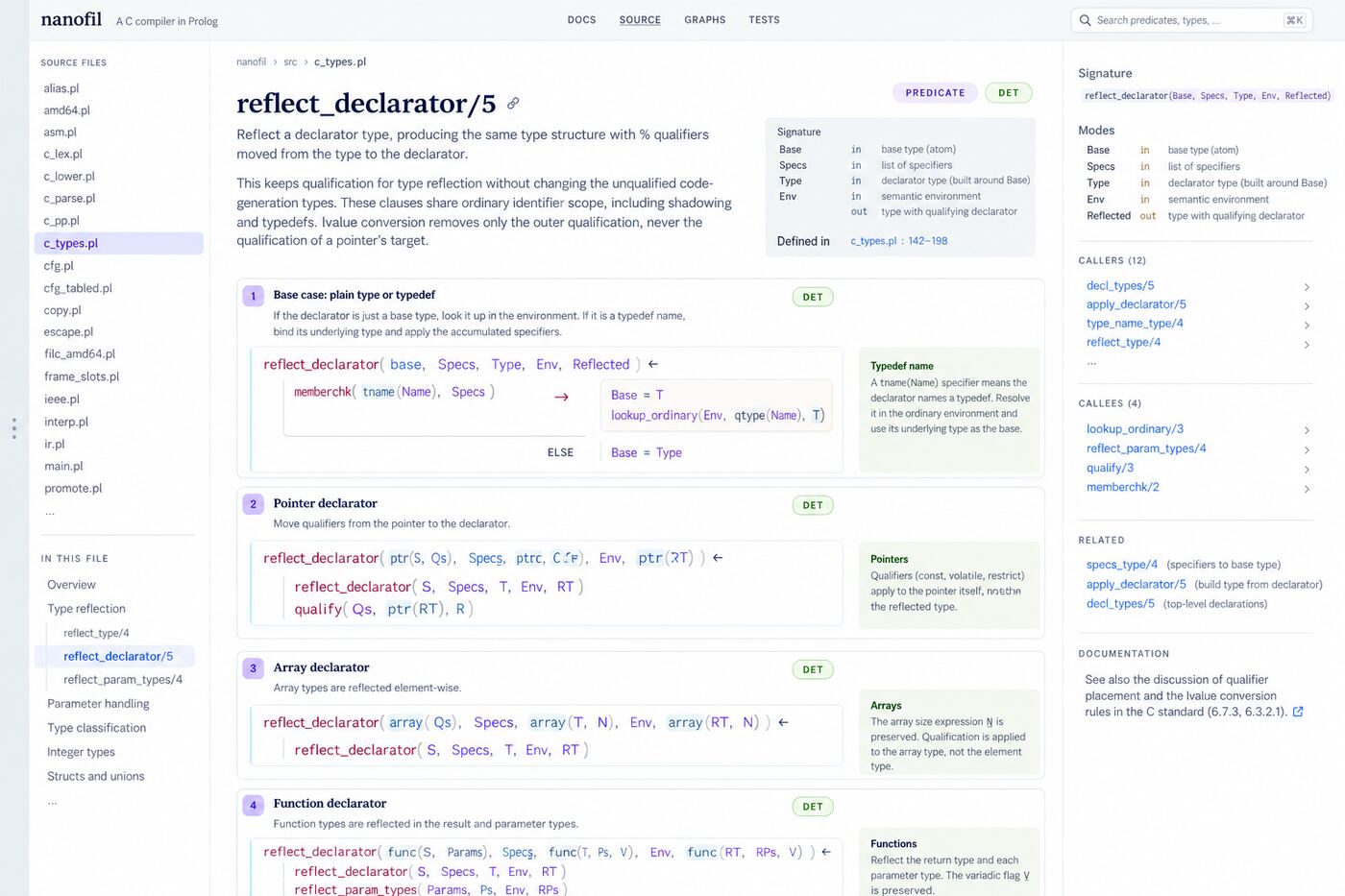
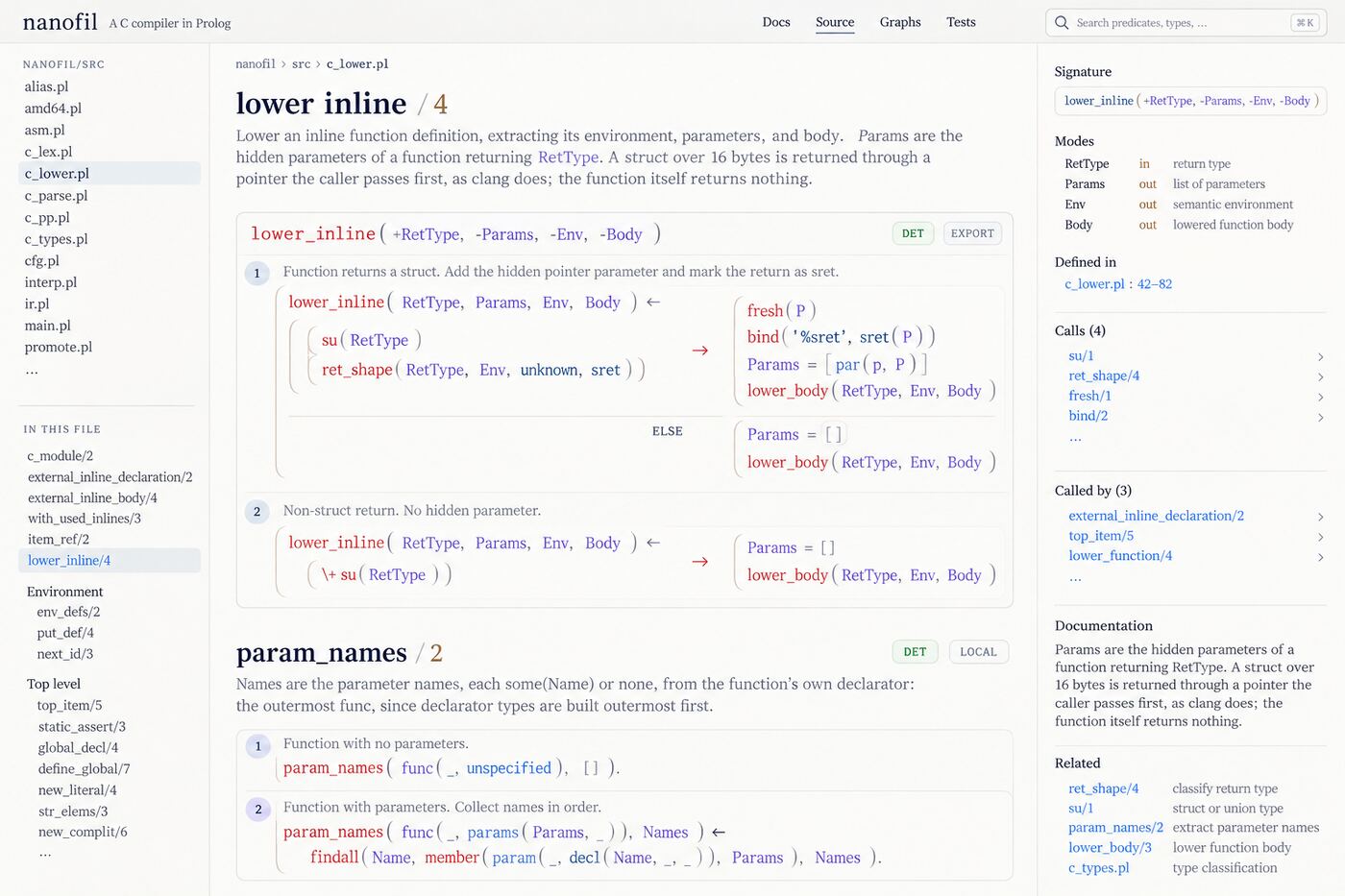
Two mockups (made with ChatGPT from v1 screenshots) pointed where to go next. The first gave a predicate a title, numbered its clauses as cases each with a caption, put an argument table beside the signature, and a panel of callers, callees and related predicates. The second, asked to attend to typography, nestled punctuation: commas hugging their arguments, parentheses close to their contents, quieter brackets.
What we took
From dexp: drawing is structure. A box per compound, flow and wrap, roles assigned in code and styled by CSS. No pretty-printer, no line breaking.
From xslt-doc: documentation in the language's own data
model. Prolog has the same advantage XSLT does, and more: code is
terms, so documentation can be terms, read by read_term/2
with everything else and, unlike XML, run.
From xslt-doc's decline: documentation that is not checked rots. So examples are goals, and a failing example fails the build.
From the mockups: numbered clauses, an argument table, cross references beside the predicate, and tighter punctuation.
doc/3
A documented module declares :- discontiguous(doc/3).
and states, just before each predicate:
doc(usual_arith_conversion(+TypeA, +TypeB, -Type), semidet, [
    TypeA: "the type of one arithmetic operand",
    TypeB: "the type of the other",
    Type: "their common real type",
    "The usual arithmetic conversions. A floating operand wins; otherwise",
    "both are promoted, and when the signedness differs the unsigned type",
    "wins unless the signed one is wider. A signed type exactly as wide",
    "as a higher-ranked unsigned one gives way to its own unsigned type.",
    cites('C11 6.3.1.8p1'),
    example(usual_arith_conversion(int, uint, T), T = uint),
    example(usual_arith_conversion(llong, ulong, T), T = ullong),
    fails(usual_arith_conversion(ptr(int), int, _))
]).- The head is the predicate's head with PlDoc modes
+ - ? @ :. Write?(X)rather than?X: SWI and Trealla disagree on?as a prefix operator, and the canonical form reads the same on both. A DCG nonterminal is documented by its head without the two list arguments; dterm matches it to the-->clauses that follow. - The second argument is the determinism:
det,semidet,nondet,multi.also(Head, Det)adds another mode. Var: "text"describes an argument.- Consecutive strings are one paragraph. Quoted text cannot span lines
on Trealla, and SWI warns about
\continuations followed by indentation, so write one string per line. cites('C11 6.3.1.8p1')cites a paragraph of the standard; dterm links it to N1570. It is the campaign's index from clause to predicate (campaign.md, Visions).example(Goal)holds when Goal succeeds,example(Goal, Check)when Goal succeeds and then Check does,fails(Goal)when Goal fails. Goals run in the documenting module.
The facts are ordinary clauses of the module: no operator
declarations, no runtime cost beyond a few kilobytes of facts, and the
same on both hosts. Nothing calls doc/3 but the tests and
dterm.
Examples are tests
tests/unit.pl's doc_examples test runs
every example of every module listed in documented_module/1
on both hosts, as part of
nix build .#checks.x86_64-linux.nanofil. dterm runs them
again when it builds the pages and marks each ✓ or ✗, so a page shows
whether it was true at its revision.
Planting SizeA >= SizeB in
usual_arith_conversion/3 (signed llong wins
over ulong) fails the unit test with
  c_types: example(usual_arith_conversion(llong,ulong,_),_=ullong) does not hold
FAILED doc_examples
and the page shows it:
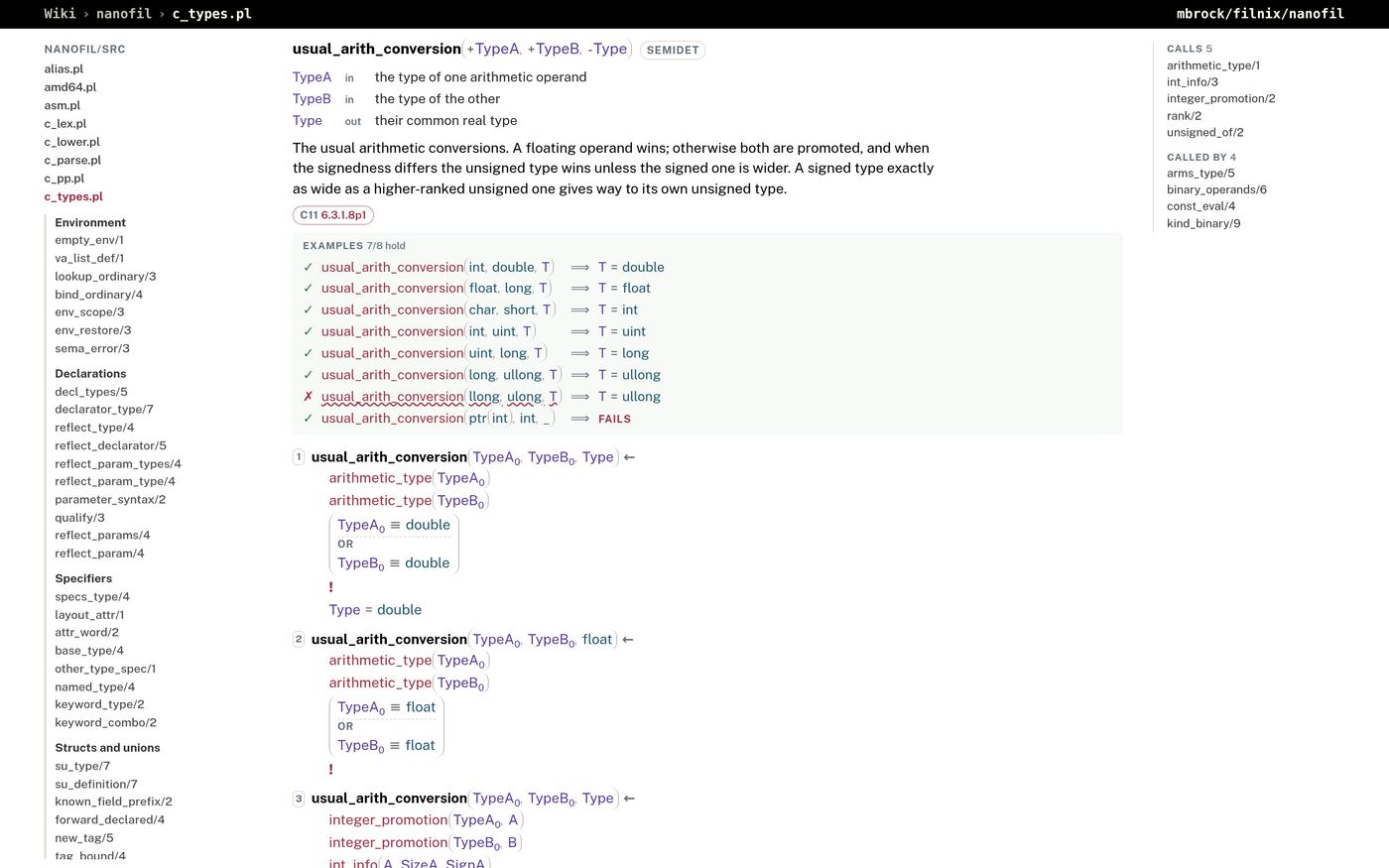
dterm v2
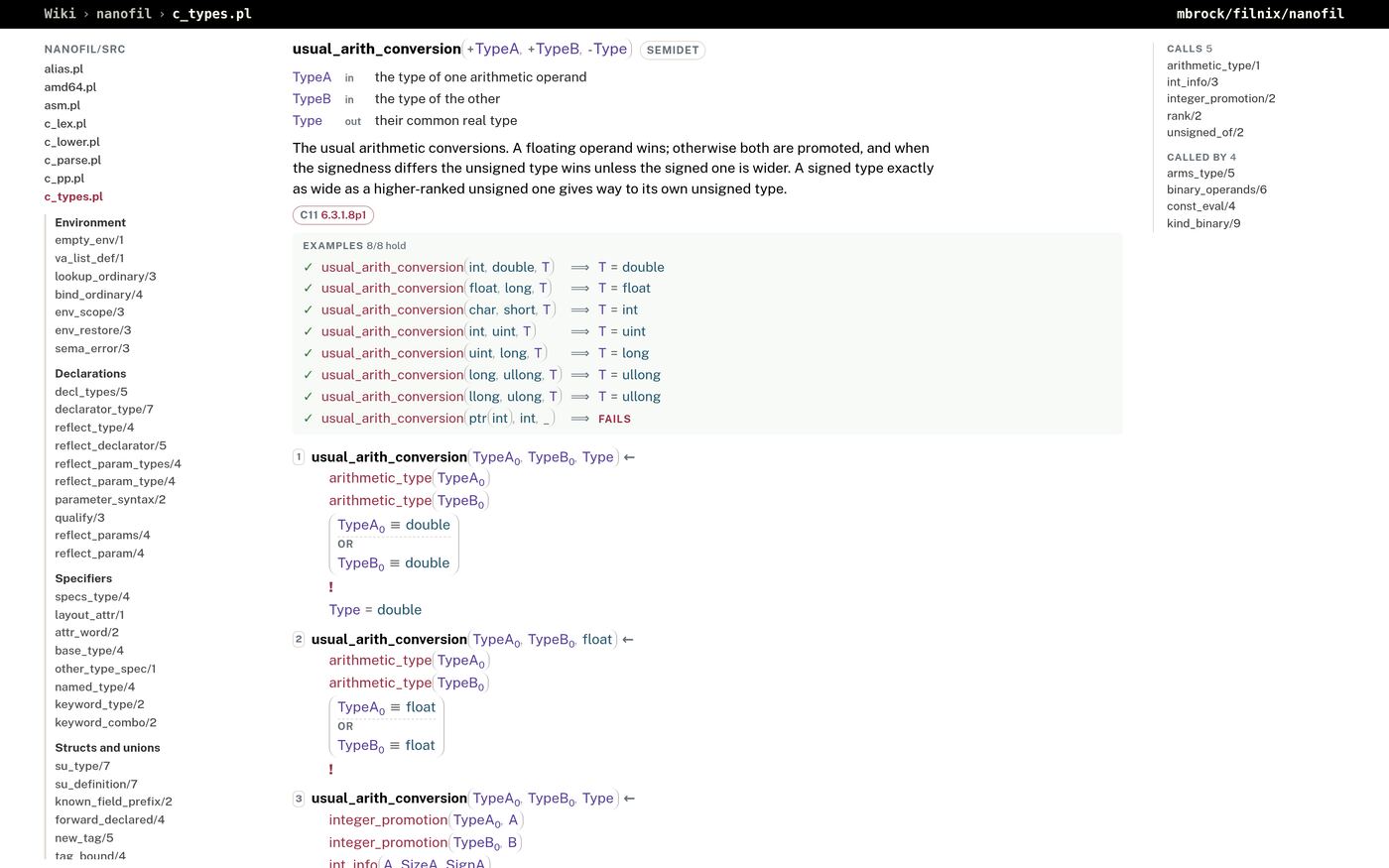
doc/3facts render as the signature with its determinism badge, the argument table (name, in or out, description), the prose with argument names marked, citation chips, and the examples with their results.- A predicate with several clauses numbers them, as cases of one definition; a comment before a clause is its caption.
- Each predicate lists the corpus predicates it calls and those that
call it, from a call graph built over every clause body (meta-calls such
as
maplist/N,findall/3andphrase/2,3included). On wide screens they sit beside the predicate. - Commas and parentheses sit closer to what they belong to.
- dterm loads the documented modules on SWI through
src/swi/compat.pl, exactly asbin/nanofildoes, to run the examples. Other modules are only read.
Terms as type (October 2026)
v2 drew every compound as a flex box whose arguments were items. That
gave the right nesting but the wrong typography: the gap after a comma
was a flex gap, so a comma floated halfway between its arguments; a line
could break anywhere between items, even between a functor's box and its
neck; every paren box was as tall as its line, so tmp(v0)
in a run of IR had a frame round it heavier than the name it held;
brackets looked like parentheses; and a long term wrapped wherever the
width ran out, so C syntax became a staircase of nested frames.
dterm now sets terms as text, after the conventions of mathematical setting and of Lisp's pretty-printers:
- A compound is its functor and an inline box whose side borders are its parentheses. Inline, the line breaks it as it breaks a parenthesis in prose: the opening one stays with the functor, the closing one with the last argument.
- A comma is text followed by a real space, so it hugs what it ends,
the line may break after it, and justification and word spacing treat it
as type. Wide operators (
=,≡,→,is) have a no-break space before and a space after: a line breaks after an operator, never before it. The neck←stays on the head's line. - Parentheses are hairlines that bow like the glyph
(
--paren-stroke0.1em,--paren-curve0.3em) at 34% ink, a little off what they hold (0.19em) and their functor (0.07em), so a name never touches its bow. A box with boxes inside stands 0.06em taller per level, three levels deep, as outer delimiters are set larger in mathematics, sof(g(x))shows its nesting without heavier lines. - Brackets are square, with short arms, at 60% of the atom blue; a
list never reads as a call. A tail bar
|sits with its tail, 0.1em each side. - Commas are at 52% ink: quieter than the names, firmer than v2's 30%, which disappeared against Public Sans's light punctuation.
- A head or goal too long for its line hangs its continuation lines 1.5em under the first.
- Without JavaScript a term flows and wraps as text; on a narrow screen a conditional is a column. Where its lines break is dterm.js's printer.
The printer
dterm.pl decides what a term is; dterm.js decides where
its lines break, at the width the page actually gives each head and
goal. It is Bernardy's printer ("A Pretty But Not Greedy Printer", ICFP
2017), cut to dterm, after a first attempt in the style of Zoot and the pretty expressive
printer that filled lines as prose and broke deep inside small
terms.
dterm.pl marks the groups: data-d=args on a compound or
list, whose .arg children are its items, and
data-d=op on an operator a line may break at. The printer
reads each head and goal as a document in Bernardy's operators (text,
<> with its later lines aligned where it began,
flush, and choice), measured in pixels with canvas. The
craft is in which layouts each group offers:
- arguments: all on one line; the first, and simple ones after it, on
the opening line and each of the rest on its own line, aligned under the
first or hung
--indentpast the term; or, as Lisp is set, all from the next line, a step past the functor, so a deep C syntax tree comes back left. Simple arguments fill their lines instead; a list of compound terms (instructions) is one line only within half the ribbon. - a chain of one operator: one line, or a line per operand. A comma
ends its line;
→and;start theirs, under the condition, as Prolog is written. - a group on one line has all of it on that line.
Each document gets its Pareto frontier by height, width, last-line
width and badness (a hung or Lisp layout is a little worse than an
aligned one), computed once per piece since a layout's measures do not
depend on where it starts. A layout wider than the width, or a single
line longer than --ribbon (34em: how much one line may hold
however wide the page), is dropped when it is made. The printer takes
the fewest lines, then the least bad; if nothing fits it lets the ribbon
go, but keeps the available width. If no plan fits even then, the term
keeps its natural wrapping markup rather than forcing an oversized
no-break layout.
A conditional is a table only while it fits and every branch is one goal; otherwise it is a stack whose IF, THEN and ELSE share one column, so every branch starts at the same place.
The plan is written as kpre (mbrock/kpre) writes a
paragraph: a break is a <br class="zbr"> and an
indent, every other separator a no-break space, so the browser draws
exactly the plan. html[data-planner=off] shows the text
unbroken; the workbench's Line breaks knob compares the two,
and its ribbon and hang knobs tune the printer.
The workbench
(web/workbench/) sets representative terms twice, under
presets or any knob (paren ink, stroke, bow and spacing, bracket style,
comma ink and weight, operator spacing, the ribbon and hang, v2's
layout), at phone, tablet or half-window width. The values above were
chosen there against v2, quieter and firmer ink, glyph parentheses, and
the looser spacing of the second mockup: glyph parentheses in Public
Sans are tall and light and do not nest visibly; looser spacing pulls
commas away from what they end; quieter ink loses the nesting in IR.
Praxis
nanofil's AGENTS.md now asks, for modules listed in
documented_module/1:
- A new or changed exported predicate gets a
doc/3fact with at least one example, and each case of its behaviour an example: both sides of a boundary, the failing case, and asymmetric inputs where an implementation could confuse its arguments. - Expected values come from the standard or by hand, not from running the code: the examples are how the documentation and the code check each other.
- A
%!comment that adoc/3fact replaces is removed; the same fact is not said twice. cites/1names the paragraph a rule implements, where there is one.
c_types.pl's Integers section was the first converted.
Its typing rules followed: compatible and composite types (6.2.7), the
typed tree (elaborate/3), lvalues and value conversion
(6.3.2.1), and the operators, casts, assignment and ?:
(6.5). Together they are 34 predicates with 121 examples. Writing them
as documents also flattened nested conditionals into named relations
such as composite_size/3, identifier_type/4,
designator/3 and pointed_type/4, and wrote
-> as elab(member(un(deref, E), F)), as
6.5.2.3p4 defines it.
Module headers as prose (October 2026)
A file's header comment is the lede of its page, and it had been written for an 80-column terminal: term grammars as aligned columns, fields as indented runs, all drawn as one grey preformatted block. The comment now takes a little Markdown, chosen so the plain text still reads well in an editor:
## Headingand### Heading, drawn as h3 and h4 (the page's own sections are h2);- pipe tables,
| A | B |over|---|---|, where a|inside backticks stays in its cell; ```prologfences, whose terms (each ending in a full stop) are drawn as terms, and```diagramfences for a box drawing;- inline code that reads as a compound term, such as
ptr(T)ore(Ords, Tags, Defs, Next), set as a term in the colours of the code;Name/Arityand anything that does not read stays code.
Indented lines are still a preformatted block, so an unconverted
header draws as before. c_types.pl was converted first, its
type terms, the environment and its definitions and members each a
table; the other modules followed.
The guide as a page (October 2026)
guide.md is drawn by web/dterm_guide.pl,
included in dterm.pl, as nanofil/guide.html beside the
module pages. The Markdown stays the source and reads the same on
GitHub. On the page:
- Each example output is drawn from its terms, the
output(Name, Items)facts tests/guide.sh writes to guide/outputs.pl from nanofil's own predicates, never by parsing the text in the fence. Assembly and C stay text. - Inline code that reads as a term is drawn as one, and IR temporaries
as the playground draws them. A
```prologfence the document writes itself is drawn as terms too, its%comments on their own lines or after a term kept as notes; a fragment such as two instructions needs no full stop, and a fence with a comment inside a term stays text. [name]links to a name the Rocq defines;[Nfb.decode]picks the one inNfb.vwhen several files define it.- Numbered lists are lists, and a
#heading after the title names a part, listed in the contents above its sections. name/N,name//Nandmodule:name/Nlink to the definition, with a card of its PlDoc signature and first paragraph on hover;name.pland../src/name.pllinks go to the module's page.- An emphasized or code mention of a concept's name links to its page (Concept nodes).
- Each module page lists the guide's sections that name it and its module-map entry; each predicate's aside lists the sections that mention it.
A reference that does not resolve fails the site build and
swipl web/dterm.pl --check docs/guide.md docs/formal.md src,
which the Nix check runs.
formal.md, the formal campaign, is drawn
the same way as nanofil/formal.html (dterm.pl takes any
number of --doc= documents). Each module page lists every
document's sections that name it; a document without a module map, like
formal.md, lists the sections that mention the module. A concept
mentioned in one document links to its page, and a link to a
.nix file goes to its dterm-nix page.
Diagrams
A ```diagram fence, in a module header or the guide,
stays box-drawing text in the source and on GitHub. web/dterm_diagram.pl
reads it as one of four shapes and draws it as HTML that reflows at
phone width, with module and predicate names linked:
- a frame: one box split by
├rules, with notes on the right, such as the stack frames in amd64.pl and filc_amd64.pl; - a pipeline: data joined by
│/▼steps, such as the guide's; - chains:
Label: A ─▶ Blines, such as opt.pl's pass orders; - boxes joined by arrows, such as main.pl and ir.pl.
A shape is used only when it accounts for every line. Anything else stays text in a block that scrolls sideways, so an unusual diagram never draws wrong.
Nix (November 2026)
dterm-nix
draws filnix's Nix the same way, on the wiki at mbrock.github.io/filnix/nix:
a Nix grammar written as a DCG reads each file into terms with positions
and comments, attribute sets and let become tables of
bindings, and dterm.js breaks the inline terms as it breaks Prolog's. It
shares dterm.js, dterm.css and web/dterm_html.pl (the HTML DCGs and the
Markdown of comments) with these pages. Two of its pages are facts
rather than source: ports.nix as a table of steps per port, and an
option index from evaluating the NixOS and finix modules.
Rocq (November 2026)
web/rocq,
dterm-rocq, draws the formal campaign's Rocq (formal.md) the same way, on the wiki at mbrock.github.io/filnix/nanofil/rocq:
a Rocq grammar written as a DCG reads each .v file into
terms with positions and comments; inductive types become tables of
constructors, step relations and theorems inference rules with their
proofs folded under them, and dterm.js breaks the inline terms as it
breaks Prolog's. Rocq in formal.md's prose
(cap := None | Obj base, Ret v, the
Theorem) is drawn as Rocq, beside the Prolog it transcribes
drawn as Prolog. It draws the Campaign 1 development in rocq/.
Concept nodes (November 2026)
nanofil is meant to read as one literate program in three languages:
the Prolog that compiles, the Rocq that models it, and the documents
that explain both. Their terms (a capability, a renew, a doomed frame)
were explained in the guide's glossary, again in a module's header, and
again in a .v file's header, each a little differently. A
concept node is the one place a term is explained, after Roam's and
Obsidian's pages: a file concepts/ID.md,
linked from everywhere it is used.
# doomed frame / doomed / doom

A frame whose check_ahead failed early: ...- The title line names the concept and its other names, separated by
/; any of them, with any case,-,_or a space alike, or with a plurals, links to it. The first paragraph is its summary: the hover card, the index entry, and what a reader sees first where it is embedded. It names the predicate, module or Rocq definition that defines it (ir:covered_access/6,[valid_no_unchecked]), or the check fails. [[name]]or[[name|shown text]]links to a concept from a Prolog comment, a(** … *)comment of the Rocq, a document or another concept, with its summary in a card on hover. A line that is only![[name]]draws the whole concept in place, so a Prolog header and the.vfile that transcribes it can both show one explanation instead of each keeping a copy. An emphasized or code mention of a concept's name in a document links to it as well, as glossary terms did.- Each concept is a page,
nanofil/concept-ID.html, ending with everything that links to it: document sections, other concepts, predicates (the one after the comment that links) and Rocq definitions.nanofil/concepts.htmllists them all with their summaries; the guide's Glossary is that list. - web/concepts.pl
reads the concepts and resolves names; dterm.pl
(
--concepts=DIR) draws them for the Prolog and the documents, and dterm-rocq (--concepts=DIR) for the Rocq. With--rocq=DIR, dterm.pl also reads the model's.vfiles, so[name]in a document or concept links to the Rocq definition and the concept pages know which Rocq comments link to them. swipl web/dterm.pl --check docs/guide.md docs/formal.md src --concepts=docs/concepts --rocq=rocq/theories, which the Nix check runs, fails on a[[name]]that names no concept anywhere in the Prolog, the Rocq or the documents, and on a concept that names no source. A C23 attribute,[[gnu::packed]], and anything in backticks is not a link.
C in prose (November 2026)
C written into documents and comments is drawn from nanofil's own parse (web/c): c_lex lexes it and c_parse reads it, as the compiler would, and c_draw sets what they read the way dterm sets terms.
- A
```cfence, in a document dterm draws, a module header or a Rocq(** *)comment, is drawn as a file is: a function is its signature over a column of statements,if/else ifone chain,switcha table of its labels, a struct a table of its fields. Its names link to their definitions in the fence. A function has an IR link to the playground, which compiles the fence and opens that function's checked IR, when the fence compiles there by itself: it includes headers, or calls only its own functions. - Inline, write
`c: EXPR`: the code afterc:is C, read as an expression, a type, a statement or a declaration, whichever reads whole, and drawn in the colours of the code with dterm's bows:`c: n->value`,`c: s += n->value;`,`c: struct { int lock; void *owner; }`. On GitHub it reads as code with ac:tag. Code that does not parse is drawn as its tokens. - Unmarked inline code is drawn as C only when it is C beyond doubt:
it reads whole as C and has a C keyword, such as
sizeof(void *),long double,while (n)orint main(void) { return 0; }. Code that reads as a Prolog compound (typeof(type(TypeName))) or writes a keyword against its parenthesis (const(N),int(ptr)) stays Prolog, so mark C that has no keyword (n->value,argv[optind]) withc:. - Assignment is
←, equality=, an initializer≔, and≠ ≤ ≥ ∧ ∨ ¬ × −and→for->are glyphs, each keeping its C spelling as its title. Integers keep the spelling they were written with (0x1FUL).
Not yet
- Captions as data (
case/2indoc/3, naming the clauses), so a predicate's cases are stated, not inferred from comments. - Pattern analysis in xslt-doc's sense: what each clause head requires of its arguments, derived from the head.
- Relations that run backwards in their examples,
int_type(T)enumerating, shown as tables of their answers. - A dark scheme, search, and the mockups' "related" list.